Existence Is Not Control
A trailer park on a bomber base's fence line, and the question your due diligence never asks.
Avihu Marom · · 4 MIN READ
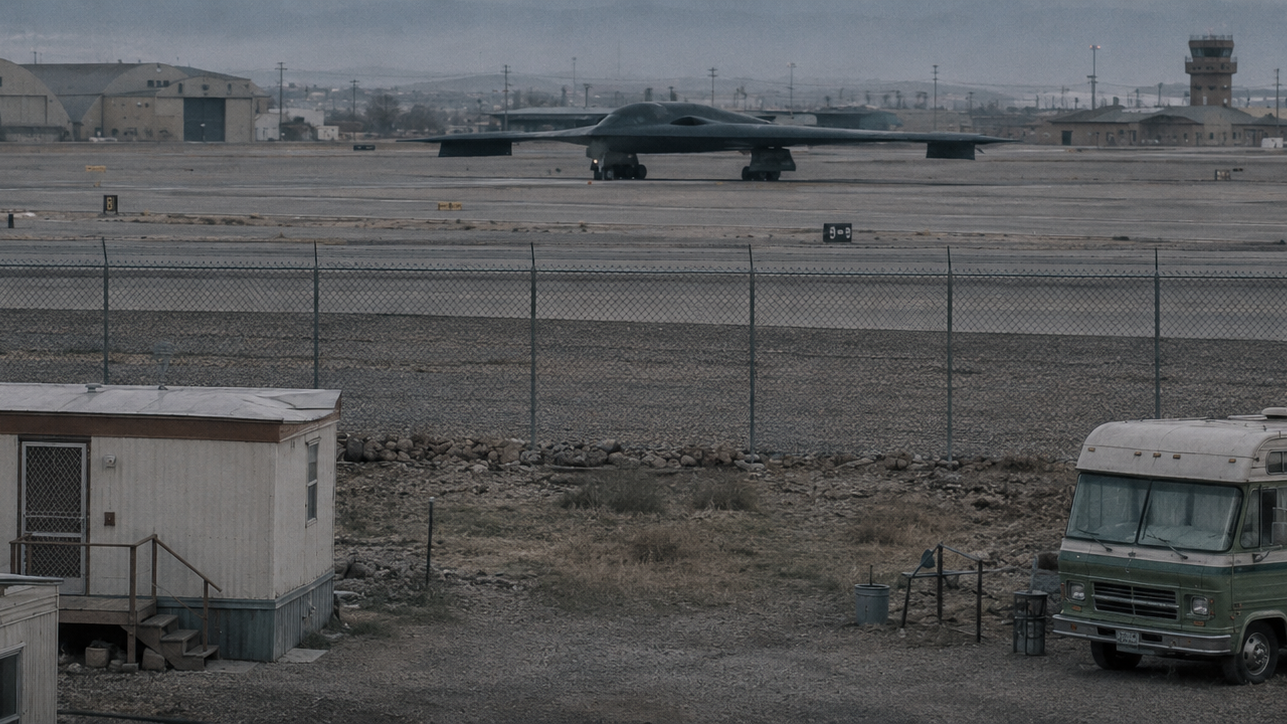
A trailer park shares a fence with the base that houses America's B-2 stealth bombers.
In January, Missouri shut down the company that ran it.
Not for spying. For paperwork.
The press read it as "China at the bomber base." That is the headline. It is not the decision.
Here is the decision. A piece of ground sat against one of the most sensitive military sites in the country for eight years. Every routine check it faced, it passed. It filed. It operated. Nobody with authority answered the only question that mattered: who actually controls it, and who can reach them.
Existence is not control. The two were never the same.
This issue is about the gap between them, and why your own process probably cannot see it either.
What is on the public record, and only what is on it.
Property Solutions 3603 LP registered in Missouri on 28 August 2017. Four days later it bought a roughly 25-acre RV park on the northern fence line of Whiteman Air Force Base.
That October, reporting says control passed to a Georgia firm owned by a Canadian couple (reported as Esther Mei and Cheng Hu; spellings vary across outlets, which is itself a small clue). Reporting then ties that couple to Miles Guo, a Chinese tycoon convicted in 2024 of more than a billion dollars in fraud.
Now the part the headline skips. Guo's loyalties are contested. He built a public profile as an enemy of the Chinese Communist Party, and has also described himself as a former intelligence affiliate. Both cannot be true as a headline. Members of Congress asked CFIUS to review the land. The state did not wait for that answer. In January 2026 it cancelled the company for failing to comply with business law, not on a proven national-security finding.
Three questions, three different answers. Who is named: known. Who controls it: traced through layers, not proven in public. What they intend: unresolved. The record cleanly answers only the first.
You do not own a bomber base. You own a fence line you have never walked.
If you are a founder or a security lead: it is the landlord of your office, the fund on your cap table, the vendor inside your network. Each one has a name you accepted and a control chain you never traced. The trailer park passed every check a busy person runs. So would yours.
If you run diligence at an institution: this entity operated for eight years and was unwound on a technicality, not because anyone answered the control question. If your process stops at "does it file and does it exist," you would have cleared it too, for eight years.
What to watch on a counterparty, before you sign:
- A company formed days before it transacts.
- Control that moves quietly after closing, into a different jurisdiction.
- A principal whose public story and whose filings do not match.
- An asset whose value is its location or its access, not its business.
The most sensitive ground in the country sat exposed for eight years. The system built to catch it did not. A compliance clerk did, by accident of paperwork. And the question the whole story turns on, who really holds it and what they want, is still not answered in public.
That is the normal state of things. Not the exception.
Run the question on your own counterparty. This is the public read. When you need to know who actually controls the name on your deal, that is a trace, and it is run privately. Request a trace.