Hormuz Reopened. Recovery Is the Real Threat Assessment
A reopened chokepoint does not mean the system has recovered.
Avihu Marom · · 5 MIN READ
Hormuz Reopened. Recovery Is the Real Threat Assessment
Reopening is not recovery.
Everyone will report a Strait of Hormuz reopening as resolution. That is the wrong frame. Reopening is a military or legal event. Recovery is a logistics, insurance, and production event. Those clocks do not move together.
In this case, they are already far apart. Reuters reported on April 8 that the ceasefire is only a two-week arrangement and that about 200 tankers in the Gulf still hold 130 million barrels of crude, 46 million barrels of refined fuels, and 1.3 million tonnes of LNG waiting for safe passage. Hapag-Lloyd said that even if the truce holds, returning its network to normal would still take six to eight weeks.
That is the real signal. Any executive doing threat assessment or business intelligence should stop reading the headline as the outcome. A chokepoint does not recover when permission returns. It recovers when vessels move, insurers reprice, terminals restart, and producers trust the corridor enough to push volume through it again. Maersk’s April 8 language said exactly that in operator terms: transit opportunities, yes; full maritime certainty, no.
The Hidden Pattern
The system recovers in layers.
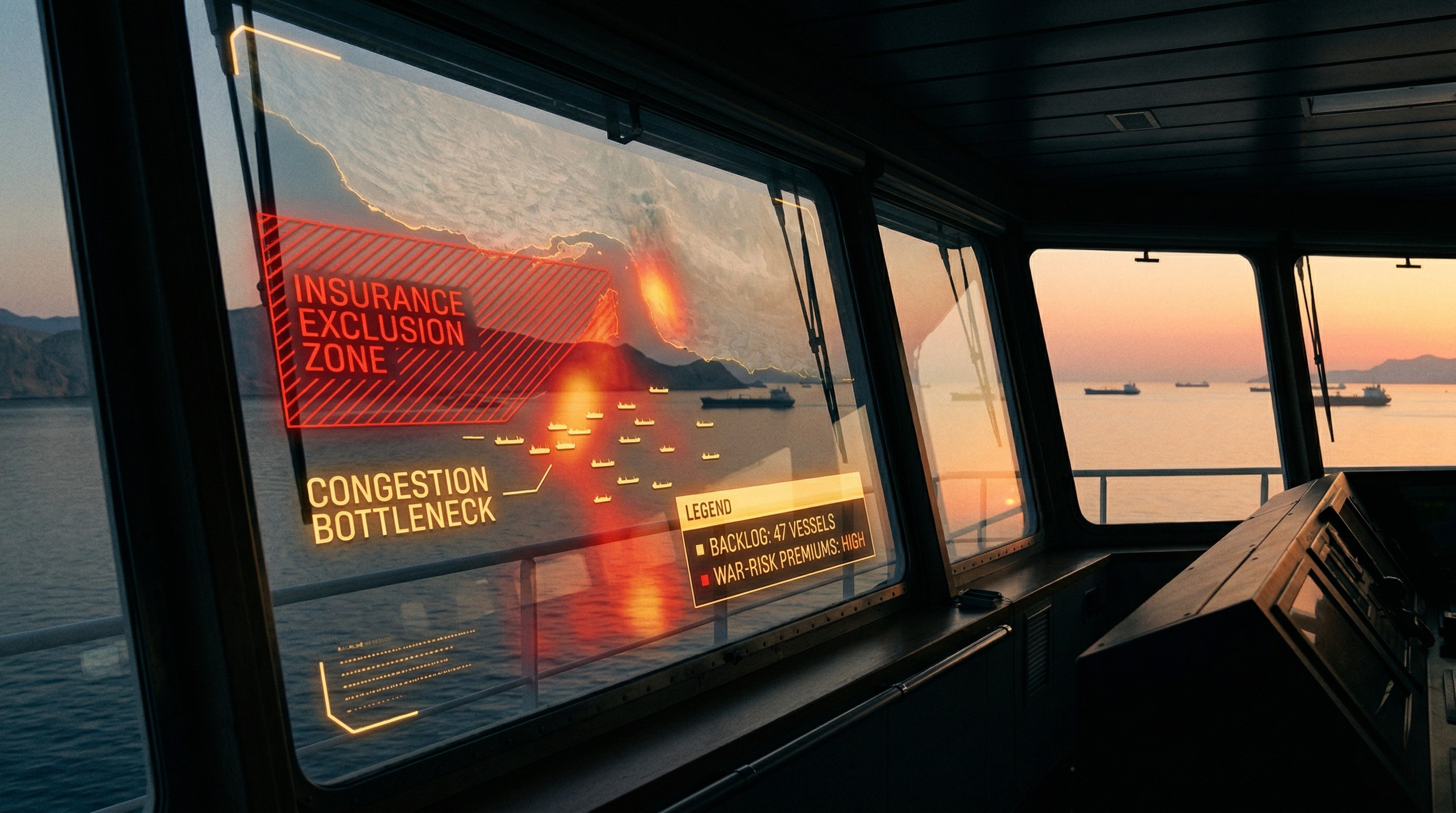
The first layer is physical congestion. Reuters, citing LSEG shipping data, said most stranded oil and gas tankers remained inside the Gulf even after the ceasefire announcement. Daejin Lee of Fertmax said more than 1,000 ocean-going vessels are trapped there and that clearing the backlog would likely take more than two weeks even under normal conditions. A 14-day ceasefire that expires before the queue clears is not recovery. It is a pause inside a traffic jam.
The second layer is operator confidence. Maersk said the ceasefire creates transit opportunities but not “full maritime certainty.” That phrase matters because maritime trade runs on commercial confidence, not political theater. The company is still basing decisions on rolling risk assessments, and it has already shifted cargo through a land bridge using Jeddah, Salalah, Sohar, and Khor Fakkan. When one of the world’s biggest carriers reroutes inland, it is telling you the sea lane is still strategically contaminated.
The third layer is insurance. Reuters reported on April 7 that maritime war-risk premiums for Gulf shipping have surged by as much as 1,000% in some cases. India is now preparing a $1.5 billion sovereign guarantee fund and a separate $300 million industry pool to keep insurance capacity alive. Governments do not build emergency insurance backstops for a route they believe is normal. They do it because the market still sees a live threat, and one industry executive told Reuters those elevated war-risk prices are expected to persist even after reopening.
The fourth layer is restart physics. Reuters reported that exports through Hormuz collapsed by around 13 million barrels per day in March, equal to roughly 13% of global consumption, forcing an estimated 7.5 million barrels per day of shut-in regional production. That includes 2.8 million barrels per day in Iraq and 1.9 million in Saudi Arabia. Restarting giant oilfields is not a switch flip. Reuters said Saudi Aramco and ADNOC are likely to hesitate before restoring output without stronger confidence in the ceasefire, while the U.S. EIA said full restoration of flows will take months even after the strait reopens.
The fifth layer is route memory. Reuters laid this out on March 25 with brutal clarity. The Red Sea mission burned through more than $1 billion in weapons, saw four ships sunk, and still failed to restore normal shipping behavior. The route remains largely avoided. Hormuz is harder: the danger zone is up to five times bigger, Iran is stronger than the Houthis, and experts told Reuters that convoy defense there is significantly more challenging than in the Red Sea. Once shipowners, underwriters, and charterers learn a route can trap assets, that memory outlasts the ceasefire.
There is a sixth layer that matters for decision-makers: dependency. Reuters reported that Asia relies on the Middle East for 60% of its oil and 80% of its gas imports. That means trapped cargo is not a regional inconvenience. It is an industrial timing problem for entire supply chains. Relief can begin before recovery is real. That is exactly why executives misread these moments. The first barrels moving again do not mean the system is healthy. They mean the system is trying to stop bleeding.
The Uncomfortable Truth
Price is not proof.
The most dangerous mistake now is to confuse a market rally with a system recovery. Reuters reported Brent crude fell roughly 13% to around $95 after the ceasefire, and other Reuters reporting showed prices dropping as low as $90.40 during the relief move. That is traders removing tail risk. It is not a sign that trapped cargo moved, insurers normalized rates, or producers restarted at scale. Markets reprice fear fast. Operations recover slowly.
This is where boards get burned. Procurement teams see price relief and assume supply relief. Risk teams downgrade the event because the kinetic phase looks softer. Leadership teams hear “route open” and relax contingency posture too early. Then the second-order costs arrive: shipowners still waiting, cover still expensive, refineries still scrambling, and restart decisions still deferred. Britain’s foreign secretary said on April 8 that London would work with the shipping, insurance, and energy sectors to restore confidence as quickly as possible. That is an official admission that confidence has not returned yet.
The right dashboard after a chokepoint ceasefire is brutally simple.
- Watch whether blue-chip carriers reopen bookings without caveats
- Watch whether war-risk premiums step down for more than a day
- Watch whether the backlog burns down faster than fresh cargo enters
- Watch whether emergency state insurance measures expand or quietly disappear
- Watch whether Saudi Arabia, the UAE, Iraq, and Qatar restore output and export behavior without extraordinary workarounds
If those signals lag, the shock is still alive. It just moved from the front page to the operating model. That is the part leaders miss when they let military de-escalation stand in for economic normalization. The battlefield can cool down while the balance sheet keeps absorbing damage.
The Hard Stop
Recovery tempo is the signal.
Chokepoints punish executives who read peace as throughput. The Strait of Hormuz can reopen and stay economically damaged for weeks or months. The leaders who win this phase will ignore the applause line and watch freight, insurance, and restart data instead. Everyone else will declare victory early and absorb the second-order costs later.
When a chokepoint crisis eases, what do you watch first: military de-escalation, insurance pricing, or time-to-recovery?