Rafael’s Real Risk Is Not Privatization
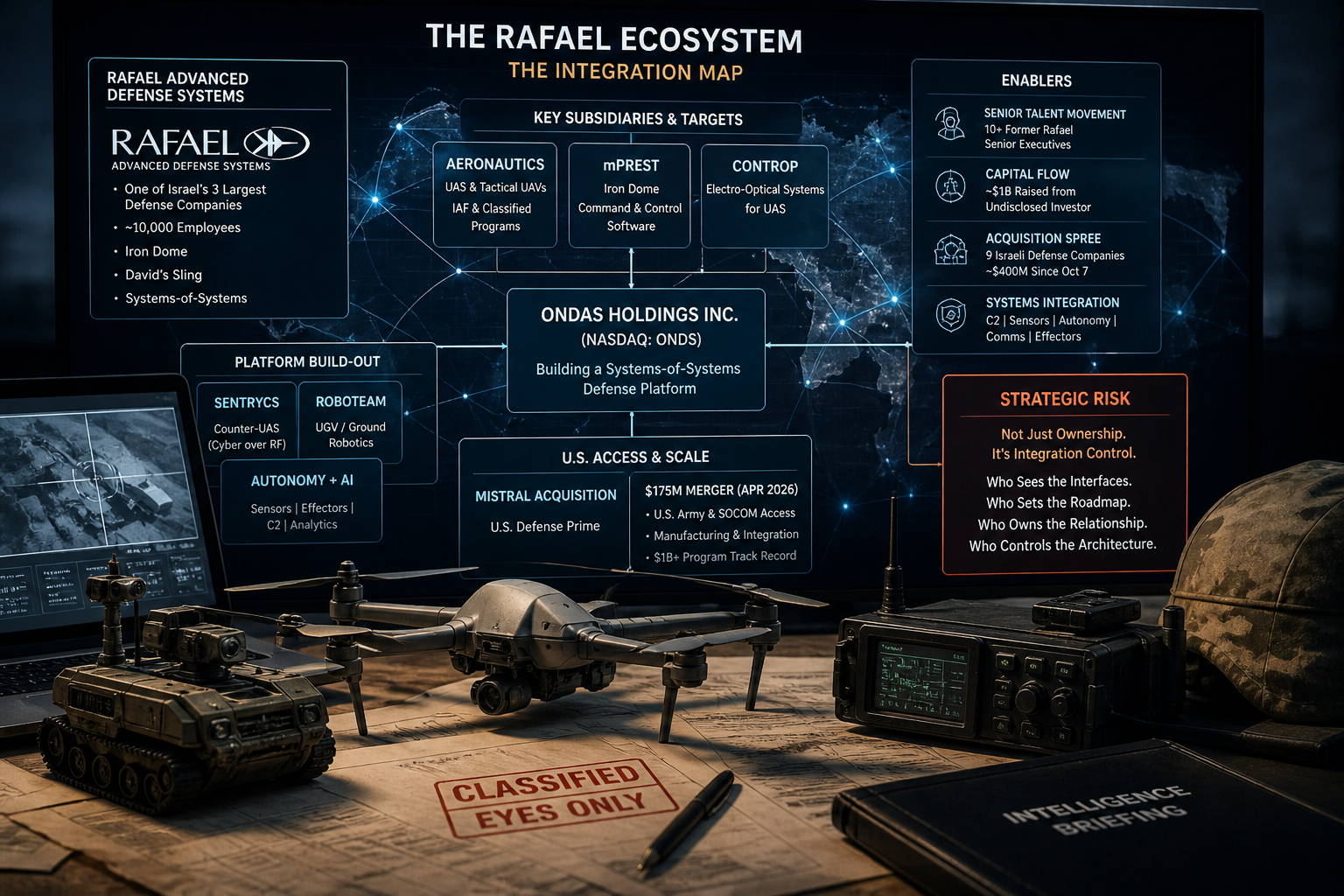
The deeper issue is who controls the integration map around Rafael: subsidiaries, senior talent, command-and-control software, sensors, autonomy, capital, and foreign defense access.
Avihu Marom · · 7 MIN READ
Rafael’s Real Risk Is Not Privatization
The Break
People read the Rafael story as privatization.
That is the surface layer.
For readers outside Israel, Rafael is not a normal defense contractor.
It is one of Israel’s three largest defense companies, a state-owned strategic asset with roughly 10,000 employees and deep integration into Israel’s defense ecosystem. It develops and produces core systems behind Israel’s layered defense architecture, including Iron Dome and David’s Sling.
That context matters.
Because the real signal is not whether Rafael sells 30%, 49%, or nothing at all.
The real signal is whether Israel understands what is already moving around Rafael before the shares move.
Financial assessments indicate that Rafael is preparing a private placement at a 60-70 billion shekel valuation, potentially without a public prospectus. The Government Companies Authority reportedly supports selling up to 49%, while the Defense Ministry has pushed for tighter conditions: an Israeli offering, mainly institutional investors, and no more than 30% of each company.
That debate matters.
But it is not the whole risk.
The asset is not only Rafael. The asset is the integration map around Rafael.
Subsidiaries. People. Software. Command-and-control logic. Battlefield integration knowledge.
That is where strategic exposure leaves quietly.
The Hidden Pattern
Ondas is not behaving like a passive buyer.
It is behaving like a defense platform builder.
That distinction changes the entire story.
Open-source tracking shows that Ondas, a U.S.-registered Nasdaq-traded holding company, is trying to acquire Aeronautics from Rafael. Aeronautics is involved in classified Israeli defense projects, including unmanned systems supplied to the Israeli Air Force and Military Intelligence.
Parallel acquisition efforts are targeting mPrest, which develops Iron Dome command-and-control software, and is interested in Controp, which works on electro-optical systems for unmanned aerial vehicles.
That is not one acquisition attempt.
It is a pattern around sensitive defense nodes.
Now place that next to Ondas’s own language.
In November 2025, Ondas said its Sentrycs acquisition would accelerate its “Systems-of-Systems” roadmap, integrating autonomous platforms, sensors, effectors, command-and-control, and secure communications into one defense architecture.
Sentrycs brings cyber-over-RF counter-UAS technology that can detect, identify, track, and take control of hostile drones without GPS reliance or kinetic engagement.
A month later, Ondas completed its acquisition of Roboteam, an Israeli tactical ground-robotics company.
Ondas said Roboteam’s unmanned ground vehicles are used for EOD, ISR, hazardous-environment missions, logistics support, and urban operations, and that the acquisition connects ground robotics with aerial autonomy, counter-UAS, AI analytics, and secure command-and-control.
Then came the U.S. channel.
In April 2026, Ondas completed a $175 million merger with Mistral, a U.S. defense prime contractor.
The company said the deal gives Ondas direct access to U.S. Army and Special Operations contract vehicles, U.S.-based manufacturing, integration capacity, and federal contracting infrastructure. It also said Mistral had captured programs exceeding $1 billion in value.
Connect the pieces.
- Israeli battlefield technology
- U.S. defense-prime access
- Counter-drone systems
- Ground robotics
- Autonomy
- C2
- Sensor integration
- Capital
This is why the Rafael-linked assets matter.
mPrest is not just software. It sits near Iron Dome command-and-control logic.
Aeronautics is not just drones. It is tied to classified Israeli defense projects.
Controp is not just electro-optics. It is part of the sensing layer for unmanned systems.
If these nodes move into a system-of-systems platform, the issue is not only ownership.
It is integration control.
Who sees the interfaces.
Who controls the roadmap.
Who owns the customer relationship.
Who decides which Israeli capability nodes become part of a larger foreign-controlled operational architecture.
That is the deeper pattern.
The Uncomfortable Truth
Formal ownership does not equal strategic control.
A defense company can remain Israeli on paper while parts of its advantage move through people, subsidiaries, capital, and integration channels.
Market data reveals that Ondas has acquired nine Israeli defense companies for roughly $400 million since the October 7 war.
It also reported a roughly $1 billion capital raise from a main investor whose identity Ondas declined to disclose, a fact that has raised questions inside Israel’s defense establishment and is being examined by the Ministry of Defense in connection with sensitive transactions.
That does not prove hostile intent.
It proves the review cannot stay inside a corporate-law frame.
In defense technology, capital becomes access. Hiring power. Acquisition power. Board pressure. Product priority. Future dependency.
Then comes the human layer.
It was reported that at least ten former senior Rafael managers and employees moved to Ondas in the past year, including a former CEO and four former vice presidents exposed to Rafael’s most sensitive secrets.
The article quoted a senior defense source saying Rafael is already “completely penetrated” by Ondas.
That is the flare.
Strategic knowledge does not live only in classified files.
It lives in people.
It lives in failure histories, supplier reality, officer trust, integration shortcuts, and battlefield compromises.
A regulator can examine a transaction.
It can block a share transfer.
It can approve or delay an acquisition.
But if it does not map the integration layer, it will miss the real exposure.
- Equity is one channel.
- Subsidiaries are another.
- Former executives are another.
- Capital opacity is another.
- U.S. defense-prime access is another.
- System-of-systems integration is another.
Reviewed separately, each looks manageable.
Connected, they form the map.
That is where Israel should look.
Not only at who buys Rafael shares.
At who is assembling the nodes around Rafael into an architecture Israel may not fully control.
The Hard Stop
The first question is not whether Rafael should be privatized, or whether Ondas should be allowed to buy.
The first question is this:
What exactly is Rafael’s strategic integration map, and who controls it as one system?
Because if Israel reviews equity, subsidiaries, talent, capital, and integration separately, the exposure will not look like a breach.
It will look like business development.