What a Probabilistic War Game Said About Iran Before the News Did
A documented simulation made before events unfolded, compared against what followed.
Avihu Marom · · 9 MIN READ
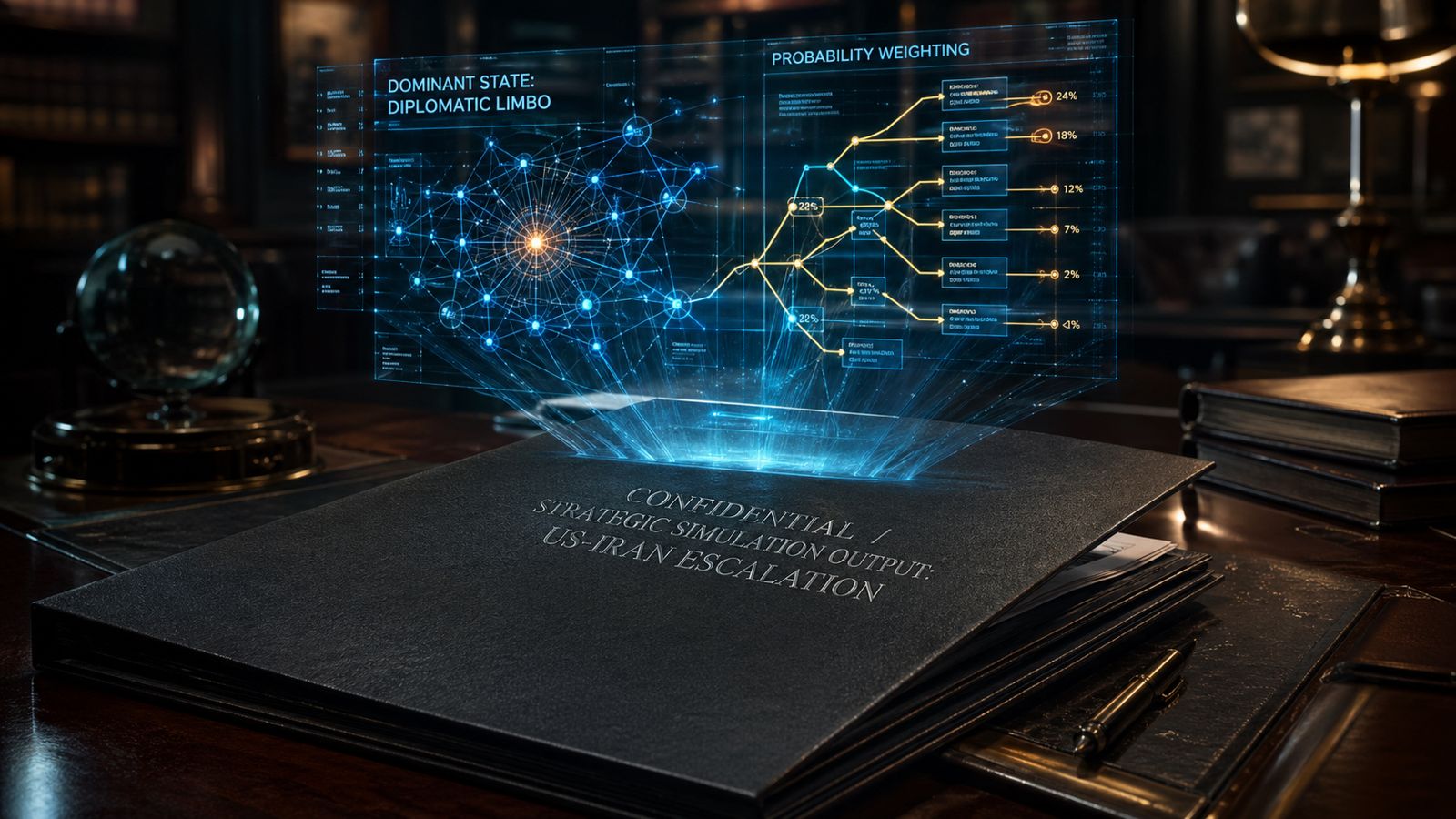
What a Probabilistic War Game Said About Iran Before the News Did
Intelligence Log | Strategic Analysis | April 26, 2026
On April 23, 2026, using the April 23 decision baseline and as the second round of the Islamabad process was being assembled, before its outcome was known, we ran a structured probabilistic war game simulation of the US-Iran negotiations.
What follows is a record of what it found, paired with commentary on how real events have since tracked or diverged from those findings.
This is not analysis of what is currently happening.
It is a documented prediction, made before the events it describes, compared against those events after they occurred.
That distinction matters more than any individual finding.
The Scenario and the Actors
The scenario modelled was the US-Iran nuclear negotiation track as of April 23, 2026, covering the active ceasefire extension following Operation Roaring Lion and the diplomatic framework that had emerged around the Islamabad channel after Round 1 on April 11-12.
The central question was not whether a deal would be reached.
It was how the structural dynamics between the modelled actors would evolve across successive negotiating rounds under realistic constraints.
Fourteen actors were modelled.
On the Iranian side
- The IRGC Supreme Command under the Vahidi faction, as the dominant institutional hardliner and the only actor in the simulation to initiate moves in 100% of rounds.
- Mojtaba Khamenei, as the nominal Supreme Leader, operating under severe incapacitation, with his office functioning as a document-authentication mechanism rather than a genuine decision-making centre.
- The Ghalibaf-Araghchi civilian negotiating delegation, the only Iranian actor with the institutional standing to transmit a proposal Witkoff's team could receive as legitimate.
- The Pezeshkian-Hemmati pragmatist bloc, providing the economic substrate the civilian delegation's political framework required and the one channel the IRGC could not easily foreclose.
- The Iranian Bazaar, Labor, and Popular Resistance bloc, a distinct civilian economic pressure actor whose rolling strikes and mourning-closure framing created the one form of domestic pressure the IRGC could not suppress without incurring additional legitimacy cost.
On the American and Israeli side
- The Vance-Witkoff-Kushner negotiating bloc, the pragmatist track and the only US faction capable of producing a framework Iran's civilian delegation could actually engage.
- The Trump-Hegseth-NSC Hawks, the maximum pressure track, initiating public deadline architecture and escalation signaling in 17 of 17 iterations.
- The Netanyahu-Mossad-IDF security establishment, modelled as a consistent spoiler actor operating across Congressional, informational, and kinetic channels in every single iteration.
External and regional actors
- Pakistan, Sharif-Munir, as the host-state mediator, the only functional bridging channel between all parties and the infrastructure whose collapse would have ended the negotiating track entirely.
- The IAEA under Grossi, whose verification architecture and "illusion of an agreement" framing functioned as a negotiating resource for every pragmatist actor simultaneously.
- Russia, Kremlin-Lavrov, with a documented structural interest in prolonging the crisis given the oil windfall it generates, operating as a latent spoiler through the HEU custody offer.
- China, Xi-PRC, the actor with the highest combined economic leverage on both sides, managing calibrated pressure while preserving the Xi-Trump summit as its primary resolution instrument.
- The Gulf States Coalition, Saudi MBS, UAE MBZ, Bahrain, operating with documented internal fractures, with the Saudi nuclear parity demand emerging as the single most durable regional security variable across the simulation.
- The European E3 plus EEAS, the actor most acutely constrained by the energy crisis and the only party holding a legal pressure mechanism, the JCPOA snapback, that neither Russia nor China could veto.
Each actor was assigned interests, institutional constraints, resource limits, and decision-making logic derived from open-source intelligence and structural analysis of historical behaviour.
Their moves across seventeen iterations were outputs of the model, not inputs to it.
The Methodology, Briefly
The simulation runs the same scenario repeatedly through a probability engine, allowing each actor to respond to the others' moves under realistic constraints across successive rounds.
Outcomes are not scripted.
They emerge from the interaction of the actor models across each iteration.
The value of repetition is straightforward.
A finding that appears in one or two iterations is noise.
A finding that appears in sixteen or seventeen is structural.
The simulation does not tell you what will happen.
It tells you what the architecture of the situation makes probable, and it separates that from what is merely plausible or rhetorically convenient.
This run completed seventeen iterations.
Three findings emerged that diverged sharply from the conventional analytical consensus at the time of the run.
Finding One: The IRGC's Institutional Dominance Became Its Own Trap
What conventional analysis said: The IRGC's institutional weight would give hardliners effective veto power over any meaningful concession. Their ability to move first and force the civilian delegation's hand was widely regarded as Iran's most durable negotiating constraint.
What the simulation found: Across all seventeen iterations, the IRGC initiated 51 out of 51 tracked round-moves, a 100% initiation rate unmatched by any other actor in the simulation.
In 14 of 17 iterations, the IRGC's opening move within the first 72 hours was to formalise some variant of a countersignature protocol, a Wartime Security Council Directive, or a National Security Red Lines Instrument.
Each version was an institutional veto document asserting authority over the civilian delegation's mandate.
In those same 14 iterations, this move triggered a constitutional counter-move from Mojtaba's handlers within 18-48 hours, invoking Article 110 language to assert Supreme Leader plenipotentiary authority for the civilian delegation.
The result was what the simulation repeatedly labelled a dual-anchor contradiction.
Pakistan received incompatible mandate documents from the IRGC and from the Supreme Leader's office simultaneously.
It could not determine which was authoritative, and it could not synthesise them.
Witkoff's team faced the same problem.
Round 2 scheduling stalled.
By Round 3, the IRGC's 100% initiation rate had produced an ironic structural consequence.
Because every Vahidi move generated a documented institutional response, the IRGC's veto architecture had become fully legible to every external party, exploitable by Israeli Congressional operations, and targetable by sanctions designations identifying specific commanders.
In 4 of 17 iterations, the IRGC's own informational operations against their civilian negotiators backfired domestically when bazaar guild networks used leaked IRGC documents as evidence of economic profiteering.
The IRGC's institutional strength was simultaneously its strategic liability.
Real-time commentary: Iranian civilian negotiators have in recent days distanced themselves from hardliner statements in ways that appear structurally coordinated rather than improvised.
That pattern is consistent with what the simulation produced when the IRGC's visible veto posture was creating operating room for the civilian delegation rather than foreclosing it.
Whether this reflects deliberate strategy or an emergent dynamic from the institutional pressures the simulation modelled, the directional pattern matches.
Finding Two: Israeli Strikes During the Ceasefire Extension Backfired
What conventional analysis said: Israeli precision operations targeting Iranian nuclear personnel during active ceasefire extensions would harden IRGC positions, destabilise the civilian delegation, and generate sufficient pressure in Tehran to collapse the talks or reduce their scope to near-zero.
What the simulation found: Israeli spoiler operations of some kind appeared in every single iteration across all 17 runs, distributed across Congressional, informational, and kinetic channels.
In 7 of 17 iterations, Mossad executed precision kinetic strikes against Iranian nuclear scientists or IRGC-adjacent facilities during ceasefire extension windows.
In 5 of those 7 cases, the strikes produced the opposite of their intended effect.
Araghchi's delegation converted the assassinations into pro-diplomacy legitimacy moments within 6-12 hours, issuing statements framed around negotiating despite active provocation as a demonstration of commitment to the Iranian people's interests.
The IAEA, UAE, and E3 all publicly condemned the Israeli action within 24-48 hours.
In iteration 8, Trump personally distanced from the strike via a public statement.
The strikes damaged Israeli political capital with the Vance-Witkoff-Kushner bloc, the faction whose sustained support was the operational prerequisite for any agreement to hold, more than they damaged Iranian negotiating willingness.
The 2 of 7 cases where strikes did not backfire were those targeting IRGC Quds Force officers rather than civilian-adjacent nuclear scientists.
That means target selection, not the act itself, determines the diplomatic consequence.
Real-time commentary: The current state of US-Israeli coordination on the negotiations is under visible strain in ways broadly consistent with this finding.
The specific mechanism the simulation identified, namely that strikes damage Israeli standing with the pragmatist bloc more than they damage Iranian negotiating willingness, remains difficult to confirm directly from open sources.
But the directional pattern is present.
This finding warrants continued observation over the next two to three weeks as the diplomatic picture develops.
Finding Three: Diplomatic Limbo Is the Outcome, Not a Waypoint
What conventional analysis said: The current ceasefire-plus-negotiation structure is an unstable equilibrium, a transitional phase that will resolve into either a substantive framework agreement or a return to active conflict within a sixty-to-ninety-day window.
What the simulation found: All seventeen iterations converged on the same outcome without exception: a sustained state of diplomatic limbo that none of the fourteen modelled actors could unilaterally escape.
The simulation describes the ceasefire extension as having created a structural attractor.
Each actor has individual incentives to maintain it and insufficient unilateral leverage to exit.
No single actor among the fourteen possesses both the motivation and the capability to force a definitive resolution in either direction.
The dominant pathway, appearing in 17 of 17 iterations, was described as follows:
- The ceasefire extension holds indefinitely.
- No Round 2 convenes within 30 days in 14 of 17 iterations.
- The blockade continues.
- The economic clock generates converging pressure but no kinetic resumption.
The agreement-or-collapse framing that dominates most commentary is, on this analysis, a misreading of the structural dynamics.
Limbo is not the situation failing to resolve.
Limbo is the resolution.
Real-time commentary: This is the finding most directly visible in current events.
Round 2 did not produce a framework.
It did not produce a collapse.
It produced an extended ceasefire, continued Iranian uncertainty about participation given the naval blockade, and a condition all parties are publicly treating as temporary and privately treating as durable.
The simulation said this structural state would persist before Round 2 had concluded.
It remains the case now.
If the pattern holds over the next thirty days, which the simulation's structural logic suggests it will, this finding will have been confirmed not by a single data point but by the sustained absence of the resolution that conventional analysis has been predicting since April 12.
What This Simulation Is, and How to Commission One
The Probabilistic War Game Simulation is a structured analytical product that applies probability-engine modelling to complex multi-actor scenarios.
It is not opinion, commentary, or expert intuition dressed in quantitative language.
It produces documented, timestamped outputs including probability distributions across outcomes, actor behaviour profiles across iterations, and a recommended posture for decision-makers, all generated before the events it analyses have unfolded.
That documentation is the product's core value.
It makes the analysis falsifiable and its track record verifiable.
The methodology applies equally to geopolitical scenarios and to business contexts including competitive strategy, M&A counterparty analysis, and organisational crisis planning.
Any situation involving multiple actors with defined interests, constrained resources, and interdependent decisions is within scope.
Two products are available from this simulation.
The Intelligence Brief
The Intelligence Brief is a decision-grade synthesis built for institutional gatekeepers running internal due diligence on the methodology before escalating to a full engagement.
It contains the Executive Assessment, the full Escalation Dynamics section covering the Dominant Pathway, Most Dangerous Pathway, Tipping Points, and Stabilisation Factors, and the interactive HTML map.
It is not a long-form reading document.
It is the structured output a serious buyer needs to assess whether the methodology warrants a full commission.
The Intelligence Brief is priced at $495.
The Client Package
The Client Package is the full strategic deliverable.
It includes comprehensive actor-by-actor analysis, the assumptions register with confidence ratings, critical decision chains, the Most Dangerous Course of Action with indicators and countermeasures, the Recommended Posture section, the interactive HTML map, and a one-hour debrief call.
It is built for C-suite principals, risk managers, hedge fund partners, and corporate strategy and M&A leads who require an operational roadmap, not a summary.
The Client Package is priced from $2,500.
To commission a simulation of your own scenario, use the contact form at avihumarom.com and select Simulation Request as the inquiry type.
This analysis was produced from a simulation generated on April 23, 2026, using the April 23, 2026 decision baseline.
All findings were documented prior to the conclusion of Round 2 of the Islamabad process.